NetSuite Consolidation — from ownership structure to an audited group close.
A group close is more than rolling up the balances of several entities: ownership structure, consolidation method, intercompany elimination, capital consolidation and currency translation all have to work together as one continuous architecture — traceable for finance, management and external audit. NetSuite provides the foundation for this; for demanding group-accounting requirements, we extend it with our own Consolidation Extension.
One chart of accounts, multiple accounting books, a consolidation path that survives an audit.
Consolidation is more than rolling up the balances of several entities. It starts with the question of which entity, at which ownership percentage, belongs in the consolidation scope, runs through initial and subsequent consolidation, elimination of intercompany balances and unrealized intercompany profits, all the way to capital consolidation — and it only ends once every figure in the group close can be traced back to a coherent posting logic, not just to a reporting click.
Evaluating NetSuite for the first time? This consolidation architecture can already be factored into the solution design of a new implementation.
A group close typically becomes slow and error-prone where intercompany differences only surface during the close, ownership information is maintained outside the system, eliminations have to be reconstructed manually, group adjustments aren't cleanly documented, currency logic isn't transparent, changes to the consolidation scope make earlier closes hard to reproduce, or reported figures can't be traced back to their origin.
Blue-outlined steps run on NetSuite standard functionality; gold-outlined steps belong to the JPS-iQ Consolidation Extension. Actual depth per step depends on licensing, configuration and target architecture.
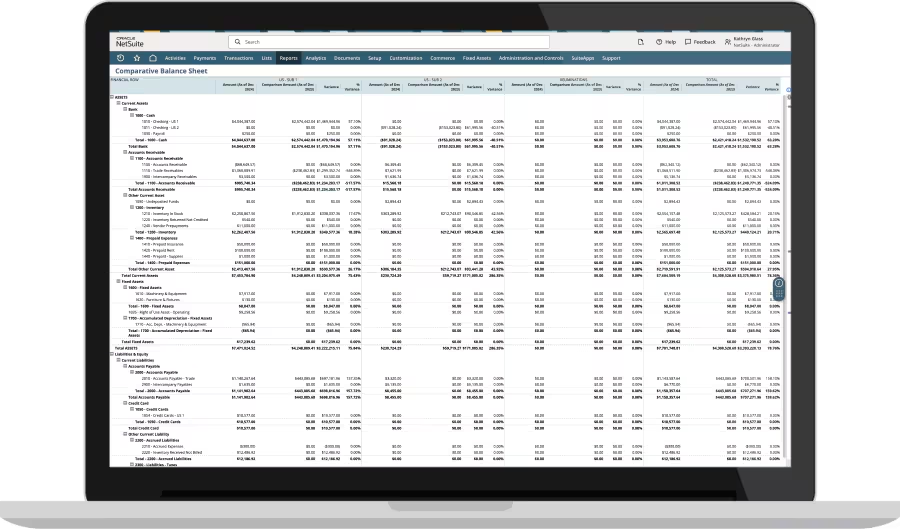
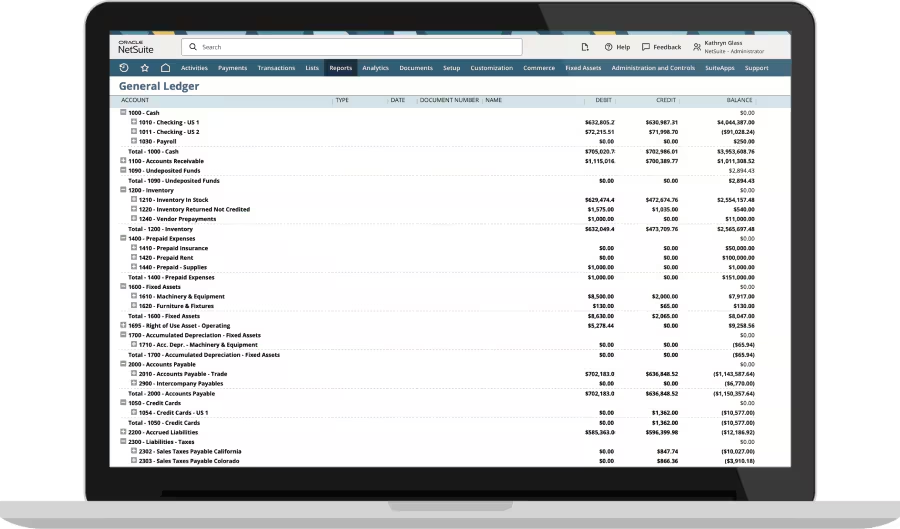
For clarity: consolidation, intercompany and Multi-Book are, technically, three distinct topics. Intercompany is an important input to consolidation, but not synonymous with it; Multi-Book is a separate accounting topic and not a prerequisite for consolidation. Both are covered here as their own chapters because they interact closely within the group close.
NetSuite as the foundation. JPS-iQ for additional consolidation depth.
Part of the consolidation architecture is plain NetSuite standard functionality — depending on licensing and configuration. For groups with more demanding group-accounting requirements, we've extended NetSuite with our own Consolidation Extension. Keeping the two cleanly separated matters more to us than the longest possible feature list.
Layer 1 — NetSuite standard
Layer 2 — JPS-iQ Consolidation Extension
Why an integrated consolidation architecture can make sense: Entities, postings, intercompany transactions, accounts, dimensions, currencies and the operational processes already live in NetSuite. When ownership structure, intercompany data and consolidation entries are brought together in the same data foundation, that can offer advantages over a separate system boundary — fewer format breaks, fewer parallel data models, fewer exports and imports, consistent master data, and tighter traceability between local finance, group adjustments, intercompany and consolidation entries. That keeps consolidated figures, adjustments and eliminations traceable back to the underlying postings and — depending on the process in question — the source documents.
This doesn't replace a specialized consolidation platform in every case. There are target architectures for which such a platform remains the right choice — for example, where very specific regulatory reporting obligations apply. The right architecture is decided by the actual target structure, not by a blanket rule.
Multiple entities, multiple currencies, and the group close is taking longer than it should? A short conversation is usually enough to pinpoint the critical architecture questions.
Discuss your consolidation architectureIntercompany billing and reconciliation.
Intercompany transactions run through a dedicated intercompany account structure with its own billing and matching layer, so discrepancies become visible during the month — rather than only at the group close. Intercompany is therefore a key input to consolidation, but technically not the same thing: consolidation decides on ownership structure, method and elimination; intercompany supplies the matched balances that feed into it.
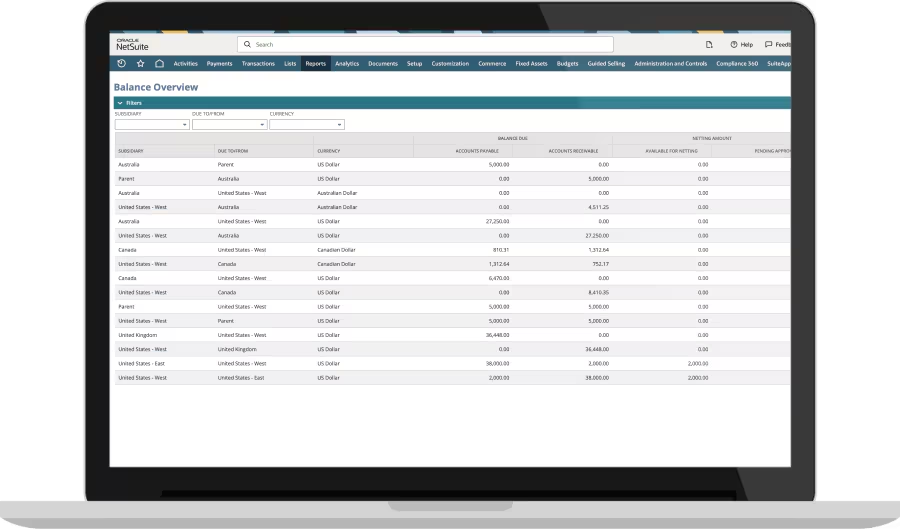
Typical triggers that bring intercompany work to us: differing IC balances between the entities involved, manual reconciliation in Excel, eliminations that don't work cleanly for partial ownership, and currency differences that only surface at the close. More on this in the deep-dive article below.
Deep-dive article: Why intercompany reconciliation still ends up in Excel →
Running local GAAP and group GAAP in parallel inside NetSuite.
NetSuite's Multi-Book accounting provides the foundation for recording one entity's transaction in more than one accounting book at once — for example, a local statutory book (local GAAP, such as HGB) and a separate group or IFRS book. Which valuations and posting logics are kept book-specific — different depreciation logic, local versus group-wide valuation requirements, or different accounting treatments, for example — is defined in the solution design on a case-by-case basis.
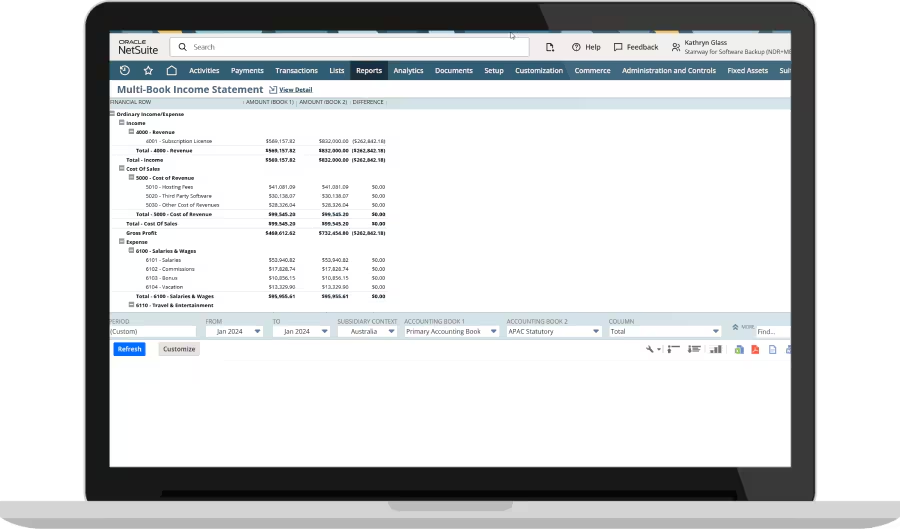
Both books usually share the same transactions and the same chart of accounts; they diverge where the accounting standards actually diverge — the exact extent depends on the setup. Multi-Book is not a component of, or a prerequisite for, consolidation — it is a separate accounting topic that becomes relevant for entities with parallel local and group-GAAP reporting, for example German entities of international groups with both HGB and IFRS obligations.
One group close, from 22 days to 8.
An industrial services group with 14 entities across seven countries was closing the month in 22 working days. We redesigned the finance architecture on the existing platform: a redesigned intercompany billing structure, a binding close calendar, and consolidation moved fully into NetSuite instead of running through a parallel Excel model.
Which consolidation architecture does your ownership structure force? Consolidation scope, method, elimination depth, Multi-Book — placed in fifteen questions.
Assess your consolidationWhat heads of group accounting want to know before implementation.
What can NetSuite already do for consolidation out of the box?
For international corporate groups, NetSuite brings a strong foundation — subsidiary structures, multi-currency, intercompany, a consolidated data foundation and consolidated reporting, depending on configuration and licensing.
For many group structures, that already covers a substantial part of the consolidation process.
When do the standard capabilities stop being enough?
Typically where ownership structures become more complex, consolidation scopes change over time, detailed capital consolidation is needed — carrying amount of the investment, minority interests, initial and subsequent consolidation — or eliminations go beyond simple intercompany balances, for example with unrealized intercompany profits.
What exactly does the JPS-iQ Consolidation Extension add?
We extend NetSuite precisely where group-accounting requirements go beyond the standard framework — among other things in ownership structures, capital consolidation, extended elimination logic and traceability.
The goal: a depth of consolidation inside NetSuite for which companies would otherwise often be looking at additional, specialized consolidation solutions.
How do intercompany and consolidation differ?
Intercompany is the billing and reconciliation of intra-group transactions — an important input to the group close. Consolidation is the combination of several entities' financial statements into one group close, including ownership structure, consolidation method and elimination.
The two are closely related, but technically they are not the same thing.
What role does Multi-Book play?
Multi-Book matters when an entity posts in parallel to different accounting requirements — local GAAP and group GAAP or IFRS, for example.
It is not, however, a prerequisite for consolidation — it's a separate topic that becomes relevant depending on the accounting requirements involved.
How do consolidation entries stay traceable?
For finance, management, external audit and internal controls, it has to remain traceable which entity supplied which value, what adjustment was made, which rate was used, and which elimination took place.
That's a consistent architectural principle, not an after-the-fact report.
When does a separate consolidation solution still make sense?
There are requirements and target architectures where a specialized consolidation platform can still make sense — for example, with very specific regulatory reporting obligations, or where an existing solution is already deeply embedded in other processes.
We recommend the architecture that fits the actual target structure, not our own bundle by default.
Consolidation that holds up to an audit — not just a reporting click.
A scope call clarifies whether your setup needs a targeted fix in consolidation, intercompany matching or Multi-Book — or a full redesign of the consolidation architecture.