
JPS-iQ Solutions Group NetSuite Finance Oracle NetSuite Solution Provider

NetSuite Finance — one system for accounting, multi-entity, and group financial statements.

Finance has to be right in the end — not just at the general ledger. A finance setup needs to bring monthly and annual close, local statutory accounting, intercompany, payments, fixed asset valuation, group reporting and controls together, while keeping every figure traceable back to how it was derived. NetSuite provides the platform for this — but whether it becomes a robust finance solution depends on the architecture behind it and how the processes interact.

Core AreasGL · AP/AR · Cash & Banking · Multi-Book
Multi-EntityNetSuite OneWorld · Consolidation · Intercompany
DACHDATEV handover · HGB/IFRS duality
Overview

What belongs to NetSuite Finance — and how it all fits together.

A sound finance design doesn't start with configuring individual modules — it starts with a series of architecture decisions that shape everything else: What belongs in the chart of accounts, and what should instead be captured through dimensions or segments? How is the legal entity structure set up, and where does that create local statutory reporting requirements alongside group GAAP standards? Where does that lead to differing valuations — for fixed assets, provisions or foreign currency, for example — and how are intercompany transactions reconciled during the year, rather than only surfacing at close?

These decisions determine how the close runs, which controls take effect, and which figures ultimately reach reporting. In multi-entity structures, a harmonized global chart of accounts is usually the most solid foundation. Local reporting requirements shouldn't reflexively be solved with additional main accounts — instead, wherever it makes functional sense, through dimensions, segments and other structural elements.

General Ledger & DimensionsWhich information belongs on the main account, which belongs in dimensions or segments such as department, class or location, and which is already available from other master data? A chart of accounts shouldn't be inflated unnecessarily just because additional reporting requirements exist.
AP/AR & CashIncoming invoice → review/approval → vendor → payment → bank → reconciliation; invoice → customer → due date → incoming payment → cash application → collections → reconciliation. Media breaks in these chains become visible at the latest during close.
Multi-BookDiffering statutory accounting requirements — local GAAP alongside group GAAP or IFRS, for example — can mean the same transaction must be valued or posted differently. The architecture needs to clarify upfront which books are required and which postings affect which book.
Close by CalendarTask sequencing plus role-based segregation of duties instead of manual approval lists — so it stays traceable who was responsible for what, and when.
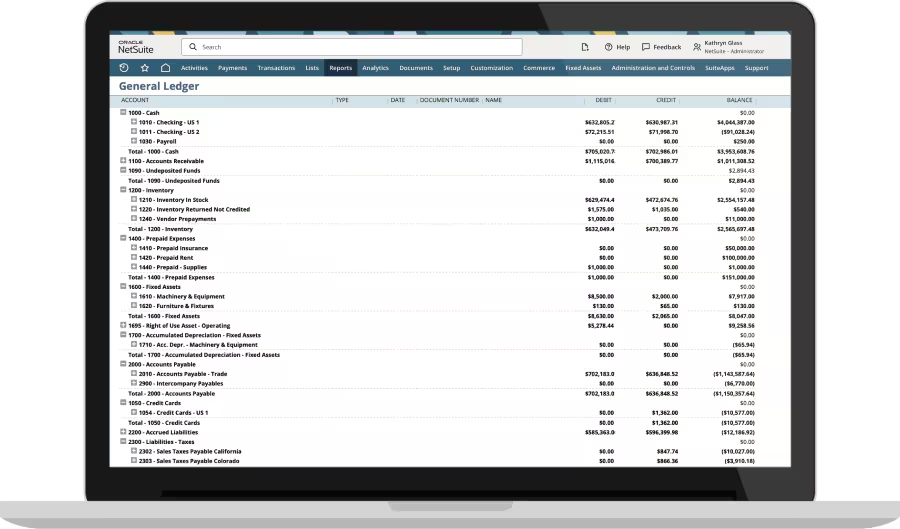
Oracle NetSuite general ledger screen
Official Oracle NetSuite screenshot — General Ledger
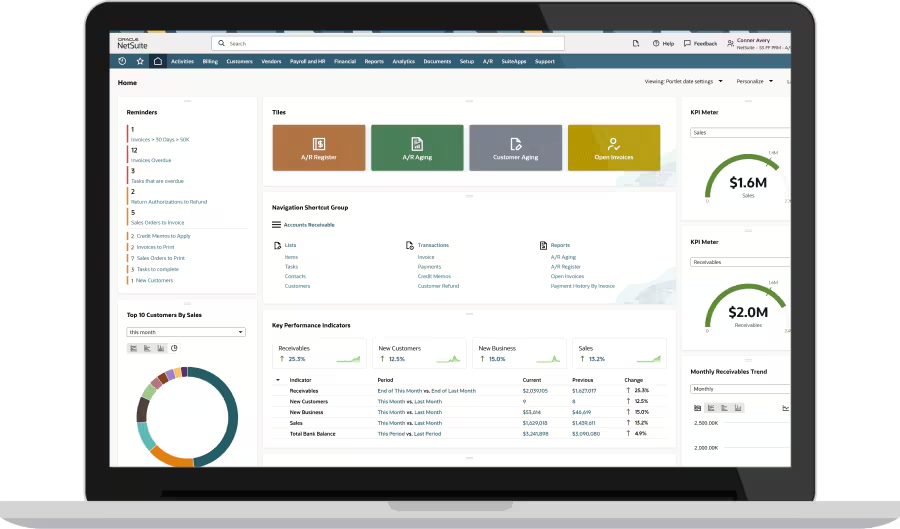
Oracle NetSuite accounts receivable screen
Official Oracle NetSuite screenshot — Accounts Receivable
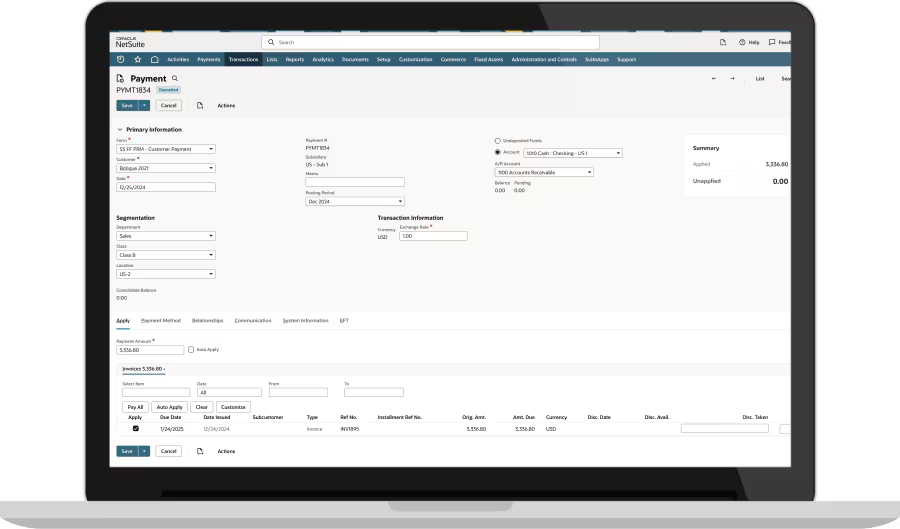
Oracle NetSuite payment management screen
Official Oracle NetSuite screenshot — Payment Management
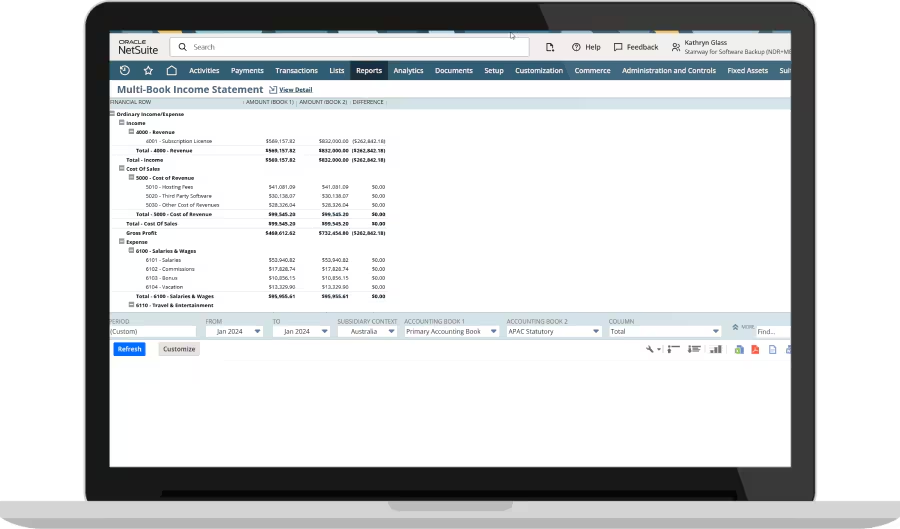
Oracle NetSuite multi-book income statement
Official Oracle NetSuite screenshot — Multi-Book Income Statement
Finance Flow

From transaction to group reporting.

General ledger, AP, AR, cash, fixed assets, inventory, intercompany, multi-book, consolidation and reporting are not independent functions — they are functionally connected, and a decision made in one place almost always has an effect somewhere else. Sound finance architecture keeps the path from transaction to group figure continuous, controllable and traceable.

Operational Transaction Subledger General Ledger Valuation Close Consolidation Reporting
Purchase-to-PayIncoming invoice → review/approval → vendor → payment → bank → reconciliation.
Order-to-CashInvoice → customer → due date → incoming payment → cash application → dunning/collections → reconciliation.
Fixed AssetsCapitalization → depreciation → general ledger.
Inventory & ManufacturingInventory → valuation → WIP/COGS → general ledger.
IntercompanyTransaction → reconciliation → elimination.
ConsolidationLocal Accounting/Books → Group Accounting → Consolidation → Financial Statements → Management Reporting.

You don't need to know yet which NetSuite functionality you need. Bring your legal entity structure, statutory accounting requirements, key finance processes and current pain points — together we'll work out the architecture decisions that actually matter.

Book a scope call
Finance Topics in Detail

Which finance architecture does your business need?

Depending on your starting point, different architecture questions arise — from your first foreign subsidiary to an existing NetSuite instance that no longer runs smoothly.

Starting point

Multiple entities and countries, but no common foundation?

NetSuite OneWorld provides the organizational foundation for companies with multiple entities, countries and currencies within a single NetSuite environment. Key considerations include subsidiary structure, currencies, local requirements alongside group-wide standards, roles and responsibilities, intercompany processes, and international rollouts.

  • Subsidiary hierarchy & multi-currency
  • Local + global accounting books
  • Template-based country rollout
Platform foundation for multi-entity More on NetSuite OneWorld →
Starting point

Group financial statements and local GAAP alongside group GAAP — and intercompany doesn't reconcile?

When multiple entities need to be consolidated into group financial statements, currency translation, intercompany reconciliation, elimination and differing statutory requirements between local GAAP and group GAAP move to the center of attention. On the deep-dive page, we set out precisely how this can be mapped in NetSuite.

  • Multiple entities → one set of group financial statements
  • Intercompany reconciliation & elimination
  • Multi-Book: local GAAP alongside group GAAP
14 entities · 7 countries — reference case View NetSuite Consolidation →
Starting point · DACH

German entity, and your tax advisor or auditor works with DATEV?

The German finance handover for entities whose tax advisor or auditor works with DATEV. The deep-dive page sets out which requirements typically arise here.

  • DATEV as the handover point for German entities
  • Framing of typical requirements
DACH-specific View NetSuite & DATEV →
Starting point · Finance × Manufacturing

Production and finance need to reflect the same economic reality.

Material movements, work orders, consumption, scrap, WIP, inventory valuation, cost variances and COGS are operational events with direct financial impact. That's why production processes, costing, inventory valuation and finance architecture can't be designed independently of one another. The Manufacturing Blueprint considers both sides together from the outset.

  • Cost layers: planned · standard · actual
  • Inventory valuation aligned with finance
  • One target model instead of two separate worlds
For manufacturing companies View the Manufacturing Blueprint →
Starting point · Existing system

NetSuite is already live — but finance doesn't run smoothly?

Typical symptoms: month-end close takes too long, intercompany reconciliation happens outside NetSuite, reporting and finance produce different results, manual journals compensate for process or setup issues, or configuration that grew organically over time makes every change harder. The root cause isn't always in the architecture — often it's in processes, data, governance or accountability. A diagnostic shows what's actually going on.

  • Health check, architecture review, stabilization
  • Concrete symptoms, concrete next steps
  • No rigid staged model
Existing NetSuite / optimization View NetSuite Optimization →
Proprietary IP

JPS-iQ Finance Add-ons

DSCAN (AI-powered invoice capture), Advance Billing, Collections and BankMatch — four NetSuite-native solutions, born from recurring finance problems in real-world projects.

  • NetSuite-native, no third-party system
  • ZUGFeRD/XRechnung, SuiteTax, OneWorld-capable
  • Born from real projects
Covered in detail on the NetSuite main page View Finance Add-ons →
Architecture in Brief

Chart of accounts, entity structure, books and close belong in one shared design.

Chart of accounts, dimensions, entity structure, books, posting logic, intercompany, close calendar and reporting all affect one another — a decision made in one place almost always has an effect somewhere else. If these are only brought together afterwards, the result is exactly the kind of valuation gaps and reconciliation problems that become visible at close, at the latest. We show how these decisions interact within a concrete NetSuite finance architecture in the full architecture deep-dive.

A jointly designed architecture rather than individual decisions merged after the fact — with a diagram, screenshots and a detailed FAQ.

View Finance Architecture in Detail
Proof

How finance architecture shows up in results.

22 → 8 daysMonth-end close, multi-entity recovery
14 entities · 7 countriesNative NetSuite consolidation, no add-on tool
€6 million avoidedRe-implementation budget avoided in one recovery program

Read the full case study →  ·  Deep-dive article: native consolidation in NetSuite →

Frequently Asked Questions

What CFOs and finance leads want to know before scoping.

Does NetSuite Finance cover our entire accounting function, or do we need additional systems?

NetSuite offers broad native finance functionality — general ledger, AP/AR, cash and payment management, Multi-Book, consolidation and intercompany. Whether additional solutions are needed depends on your specific requirements.

Typical factors: local compliance (DATEV in Germany, for example), payment and document processes, specific consolidation requirements, manufacturing costing, reporting depth, integrations, and the desired level of automation. There's no blanket answer — that's exactly what the first step of a scope call is for.

What's the difference between NetSuite Finance, NetSuite OneWorld and Consolidation?

The three terms answer different questions, and in multi-entity architectures they work closely together: NetSuite Finance — how are finance processes and statutory accounting represented in the system? NetSuite OneWorld — how is an international or multi-entity company structure organized within NetSuite? Consolidation — how are the results of multiple entities brought together into group financial statements?

That's also why we have separate pillar pages, even though the topics work closely together in practice.

How are finance and manufacturing architecture connected at JPS-iQ?

We look at finance and manufacturing together because operational production processes create financial impact: material consumption, inventory, work orders, WIP, scrap, cost variances and COGS all need to fit the valuation, posting and reporting logic.

That's why we treat production, costing and finance decisions as one shared target picture — that's what distinguishes our work from a pure NetSuite implementation.

We already have NetSuite in place, but finance doesn't run smoothly — where do we start?

With a NetSuite System Health Check. In 3 to 5 days, it shows whether the problem lies in configuration, data quality, process discipline or actual architecture — and which next step is worth taking.

More on the bigger picture: optimizing, stabilizing and evolving NetSuite.

Contact · NetSuite Finance

Clarify the architecture first. Then decide on modules.

A single scope call is usually enough to clarify which finance topics actually matter for your entity structure — consolidation, NetSuite OneWorld, DATEV, or all three together.