
JPS-iQ Solutions Group NetSuite Manufacturing Oracle NetSuite Solution Provider Manufacturing Blueprint · SAP-style depth

NetSuite for Manufacturing — at the depth production actually demands.

SuiteSuccess carries for standard manufacturing. As soon as BOM variants, routing scenarios, costing layers, WIP and multi-site planning need to interlock, the standard becomes too shallow. The JPS-iQ Manufacturing Blueprint picks up precisely there — at SAP-style depth, finance-wired, not approximated.

Production typesDiscrete · Process · Make-to-Order · Hybrid
DepthBOM · Routing · WIP · Cost Layers · MRP
DeploymentMid-market and enterprise, multi-site, multi-entity
SuiteSuccess gap

Where SuiteSuccess ends. Where the Blueprint begins.

We are not anti-standard. We run SuiteSuccess where it carries. But in manufacturing with real variant, cost or planning depth, the standard reaches a clean structural boundary. That is where the extension begins — controlled, documented, finance-grade.

SuiteSuccess · Standard

Carries well up to here

  • Simple, linear bills of material
  • Standard routings with few variants
  • Standard costing with a single cost layer
  • Single-site or simple multi-site logic
  • Basic MRP without complex capacity control
  • Basic WIP without differentiated variance analysis
Manufacturing Blueprint · depth

From here it becomes structural

  • Variant BOMs with shared master-data logic
  • Multi-level routings with scenarios and alternatives
  • Multiple cost layers (plan · target · actual) cleanly separated
  • Multi-site planning with plant network and intercompany logic
  • MRP plus finite capacity and setup-time modelling
  • WIP, variances and actual costing wired into finance

The transition between both columns is a decision per process stream, not a blanket deviation. Exactly these decisions are made inside the Blueprint — before anything is built.

Not sure where the gap line really runs in your setup? A short architecture read is usually enough to identify the three to four critical decisions.

Book a 15-min gap call
The JPS-iQ Manufacturing Blueprint

One manufacturing architecture. One cost truth. One system.

The Blueprint is not a module and not a SuiteApp list. It is the target model for manufacturing in NetSuite: master data, process logic, costing logic, planning logic, finance wiring and governance — in one coherent design. Only then are standard, SuiteApps and custom development positioned.

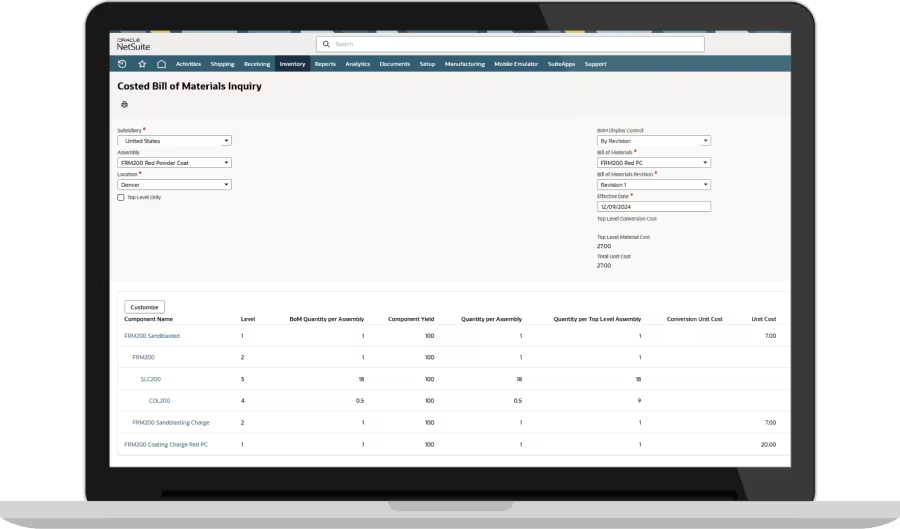
  • BOMs, variants, phantoms and lookup master data cleanly separated
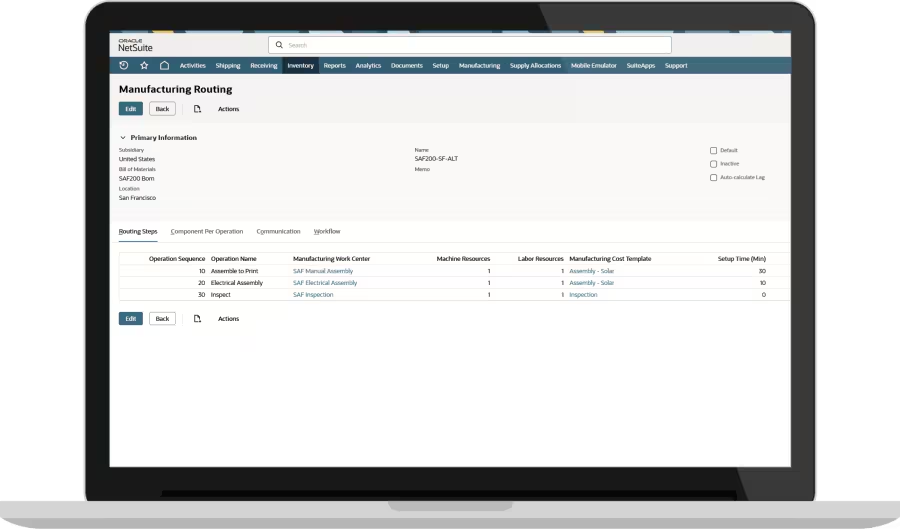
  • Routings, work centres, setup times and alternative routings modelled
  • Costing with plan, target and actual layers, WIP and variances
  • MRP with finite capacity, plant network and multi-site logic
  • Inventory valuation, period accruals and finance wired — not reconciled
  • Governance and rollout model for multi-entity and multi-country footprints
SAP-style depth Built to the architectural depth enterprise manufacturing expects.
Finance-native Product cost coupled to the numbers truth — not reconciled downstream.
Beyond SuiteSuccess Controlled extension where the standard structurally ends.
∞ scalable Multi-site, multi-entity, multi-country without re-implementation.
Free whitepaper · 24 pages

The JPS-iQ Manufacturing Blueprint — as a structured target model.

The whitepaper shows where the NetSuite standard ends structurally in manufacturing, how we build the Blueprint at SAP-style depth and how costing, planning and finance are wired to each other. Plus a short gap-check checklist for internal use.

  • Gap analysis: where SuiteSuccess ends in manufacturing — and why
  • The Blueprint in six layers: master data to governance
  • Cost-layer model (plan · target · actual) with finance wiring
  • MRP plus finite capacity — without a separate APS system
  • Decision checklist for the first internal architecture conversation
Connected directly to NetSuite CRM. No spam. One-time delivery plus optional insight subscription.
What separates our approach

We build NetSuite where no other partner takes it — and where SAP/ABAS customers need to land.

That is the actual JPS-iQ USP, and we will not soften it. Most NetSuite Manufacturing implementations stay at SuiteSuccess and stop at the door of real production complexity. We deliberately step past that door. Our Manufacturing Blueprint is an industry-aligned target model — built against ISA-95, MRP II and SCOR — that delivers the functional depth SAP and ABAS customers expect, while keeping the implementation speed, cost profile and operating agility that NetSuite is bought for. Most NetSuite partners cannot take a manufacturer this deep. Most SAP and ABAS partners cannot deliver at this speed. We do both. Five principles separate our work from a standard NetSuite rollout.

1. Capabilities, not features

We structure manufacturing along real production capabilities — planning, scheduling, costing, quality, post-calculation — not along which NetSuite checkboxes happen to be available. The architecture is built end-to-end against ISA-95, MRP II and SCOR reference models, then translated cleanly into the system. Result: one coherent target model, not a patchwork of activated modules.

2. Fit-Gap discipline from day one

NetSuite is strong, but not perfect. We assess every manufacturing requirement against four states — native, configurable, limited, gap — and make conscious design decisions on each. Not everything gets built into the system. The right things get built. Our internal Capability Map covers 55 requirements across six function areas and is the working basis of every Manufacturing Blueprint we deliver.

3. Closing the SAP/ABAS gap deliberately

Where SAP and ABAS are strong — production control, deep process integration, complex mixed-mode scenarios — NetSuite is configurable but not native. We close that distance through intelligent process design, targeted extensions instead of blind customisation, and clear standardisation. The goal is SAP-grade depth where it matters, with NetSuite's flexibility everywhere else.

4. The traps we deliberately avoid

NetSuite manufacturing programmes typically fail in one of three ways: overengineering that turns the platform into bespoke software, wrong granularity in BOM and routing that breaks costing, or an MRP setup that no-one fully understands. We know the patterns and design against them from the first week — before they become structural debt.

5. An architecture that is actually delivered

Our Manufacturing Blueprint is not documentation that sits in a drawer. It is a decision basis, an implementation guide and a steering instrument throughout the programme. It tells the team what to build, what not to build, and how to know whether the system is on target. The difference between rolling out NetSuite and building a manufacturing platform that holds.

What we are not

We are not the cheapest NetSuite reseller, and we will not be. For single-entity standard manufacturing without finance complexity there are partners that fit better and cost less. Where this work pays off is exactly where the standard breaks: multi-site, multi-mode, deep finance, audit-grade close, and a board that needs the numbers to hold under scrutiny.

Capability review

We do not publish the Capability Map — we run it with you.

The Capability Map is our internal reference framework for NetSuite Manufacturing — 55 requirements across six function areas, assessed against ISA-95, MRP II and SCOR. We do not share it as a generic download, because the value is in the interpretation: which requirements are native, where configuration is enough, where SAP/ABAS depth needs to be engineered in. We bring it into a structured capability review against your manufacturing reality.

Method

From architecture conversation to a manufacturing system that holds.

We don't start with a module selection. We start with the decision on how manufacturing should be represented structurally in NetSuite. Implementation follows that decision — not the other way around.

01 — Assessment

Architecture clarity

Two-week assessment: operating model, finance logic, manufacturing depth, entities. Output: target architecture sketched on one page.

02 — Blueprint

Finance × industry

The Manufacturing Blueprint is wired against the Finance Blueprint — costing logic, planning logic, governance.

03 — Build & rollout

Controlled delivery

SuiteSuccess where it carries. Blueprint depth where it is needed. Roles, integrations and rollout logic in a single track.

04 — Evolution

Scaling without re-implementation

Multi-site and multi-entity extension on the existing architecture — not against it.

Who it's for

Four starting points where the Blueprint makes the difference.

Not every manufacturer needs the Blueprint at full depth. These four situations are the clearest application — this is where the return is highest.

DIS

Discrete manufacturing with variants

High BOM variance, multiple routing scenarios, product-specific costing logic — where the standard turns into approximation.

PRC

Process manufacturing with recipes

Batches, recipes, yield logic and scrap-cost allocation — wired into inventory valuation and period accruals.

MTO

Make-to-Order & Engineer-to-Order

Order-specific BOMs, project costing, actual costing and finance reporting in one coherent target model.

In pre-selection — and not sure whether NetSuite carries your manufacturing depth? We'll walk it through with you honestly. No pitch.

Book a Manufacturing sparring call
Hard questions

What Finance and Operations leaders really ask before committing.

No marketing fair weather. The questions that come up in real selection processes — with how we use the Manufacturing Blueprint to answer them.

Is the NetSuite Manufacturing Edition standard enough for our production?

For many standard processes yes. As soon as BOM variants, routing scenarios, costing layers, WIP logic, multi-site planning and actual costing need to interlock, the standard quickly becomes too shallow.

That is where our Manufacturing Blueprint picks up — not as a deviation from standard but as a controlled depth extension along clear governance rules.

What distinguishes the JPS-iQ Manufacturing Blueprint from a SuiteApp?

A SuiteApp is a module. Our Blueprint is a target model: data structure, costing logic, planning logic, finance wiring and governance — designed at SAP-style depth.

Only on this target model are SuiteApps or custom development positioned. Not the other way around — otherwise you end up with a module stack without supporting architecture.

Can we use NetSuite for both discrete and process manufacturing?

Yes — in both models and in hybrid environments. The Blueprint separates master-data logic, recipes/BOMs, routings and costing layers so that discrete, process and make-to-order lines run cleanly side by side.

More important than the ERP choice is the cleanness of master-data and costing logic.

How does the Blueprint relate to NetSuite Advanced Manufacturing and WIP & Routings?

Both modules are used where they carry. But the Blueprint defines how they are configured — cost layers, variance logic, WIP capture and actual costing are not derived from module defaults but from the target model.

That is the difference between "module activated" and "manufacturing represented at SAP-style depth".

What does a NetSuite Manufacturing implementation with JPS-iQ cost?

Commercial size depends on footprint, entities, sites and manufacturing depth. Entry is a two-week assessment with a target-architecture sketch. Only then do we discuss scope, phases and commercials.

No flat list price. No artificial license bundles as entry barriers.

How does a rescue project work when NetSuite Manufacturing is already unstable?

We start with an architecture audit: master data, BOMs, routings, costing logic, inventory valuation, finance wiring, integrations.

From that we derive a target state plus a roadmap from stabilisation to real target architecture — without immediate re-implementation if it isn't needed.

Contact · NetSuite Manufacturing

Architecture before module thinking. Manufacturing depth before SuiteApp stacks.

The Manufacturing Blueprint is the foundation on which NetSuite truly carries in manufacturing. Start with the whitepaper — or go straight into an architecture conversation.